Architecture
Foundgine keeps meaning, authority and physical execution separate. Every transport and provider fits around the same core lifecycle.
Canonical lifecycle
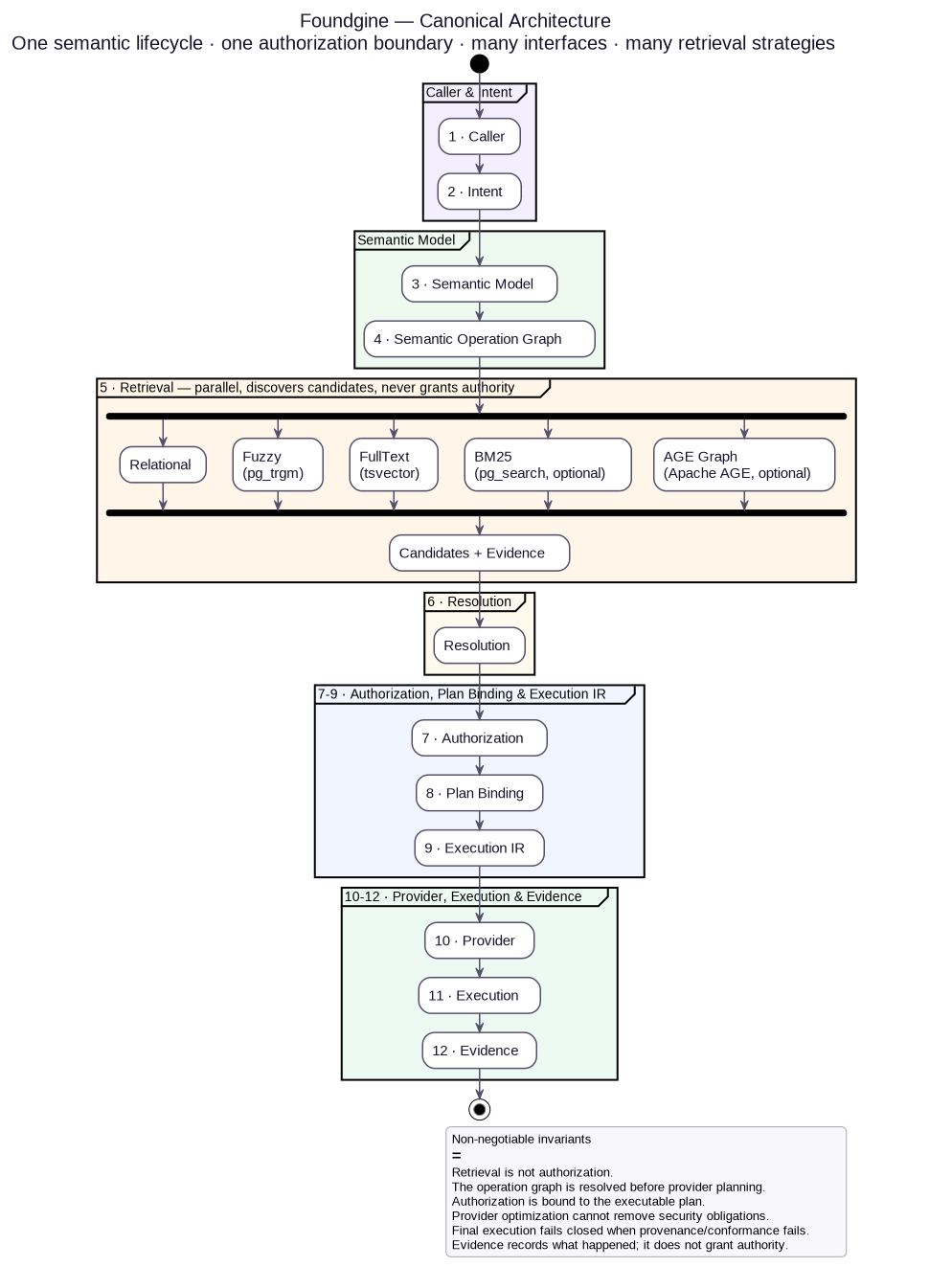
The diagram is the reference map for the entire site. Other pages zoom into individual sections rather than defining alternate pipelines.
Semantic model
The .NET Foundgine.Core package and Java foundgine-core module
own the provider-independent semantic contracts: entities, fields, relationships,
intent, resolution, validation, capabilities and authorization structures. The semantic
model describes application meaning, not storage implementation. The package and Java
package names differ, but the architectural boundary is shared.
Metadata
Structural metadata describes what exists in the underlying model. .NET uses a source
generator; Java uses an annotation processor. Both can produce runtime metadata at
compile time, but the generated type names and build integration differ. Java also has a
fluent FoundgineModelConfiguration<T> API. Metadata helps build the
semantic model; it does not replace semantic design.
Read Metadata → Semantics and AOT for the implementation details.
Retrieval and resolution
Retrieval is a candidate-discovery stage. Relational lookup, fuzzy matching, full-text, optional BM25 and optional graph similarity can provide candidates plus provenance. Resolution decides what those candidates mean against the semantic contract.
Retrieval is evidence. Resolution establishes meaning. Authorization establishes authority.
For free-form language, see Lexical grounding and Grounding decisions.
Authorization and plan binding
Authorization evaluates the resolved semantic operation graph before provider-specific planning. The resulting decision is bound to the plan through its semantic and authorization fingerprints.
Optimization can change physical shape, but it must preserve the authorization binding. The final execution gate checks that the provider artifact still conforms to the exact execution representation it came from.
Execution and providers
The .NET Foundgine.Runtime package and Java
foundgine-runtime module orchestrate execution. The .NET
Foundgine.Providers package and Java foundgine-providers
module supply SQL/JDBC, InMemory and retrieval providers. ORM adapters are EF Core for
.NET and JPA/Hibernate for Java; their capability status is tracked separately. The
extension surfaces include Hot Chocolate GraphQL for .NET and GraphQL Java for Java.
Optional Spring Boot and LangChain4j modules have source and tests, but their dependency
pins and runtime verification remain pending. Java's separate
foundgine-migrations source module generates PostgreSQL/Flyway schema
migrations from metadata; it is developer tooling, not a runtime provider, and its
Maven/runtime verification remains pending.
Provider code owns physical concerns. It does not redefine the application's semantic authorization policy.
Adapters
GraphQL, JSON and MCP integrations are callers/adapters around the same boundary. .NET
includes Microsoft.Extensions.AI and Microsoft Agent Framework adapters in
Foundgine.Providers; Java includes LangChain4j in foundgine-providers.
Full build/runtime verification remains pending for this snapshot. Adapters translate their
native request shape into Foundgine intent and receive the resulting application-controlled execution.
Security invariant
Untrusted intent
      ↓
Semantic resolution
      ↓
Authorization
      ↓
Security-preserving plan
      ↓
Provider conformance
      ↓
Execution
Capability discovery is descriptive. It never replaces authorization.