From intent to authorized execution.
Foundgine is a configurable semantic and execution boundary for application capabilities. It separates application meaning, persistence mapping, authorization and execution from the interfaces and agents that consume them.
Your enterprise has enough systems. It needs one consistent way to execute across them.
CRM, ERP, APIs, databases and AI agents should not each grow their own version of business meaning, validation and authorization. Foundgine provides a configurable semantic and execution boundary between application capabilities and the interfaces that consume them.
Define meaning once.
Reuse configured application capabilities across application code, APIs, GraphQL and optional MCP callers.
Keep authority in the application.
Resolve intent before execution. Identity and policy remain application-controlled; an AI-generated request is never permission by itself.
Keep your existing stack.
Retain your domain applications, databases, EF Core or JPA, identity provider and workflow engine. Foundgine complements existing infrastructure and can be adopted incrementally.
The business case is measurable: compare duplicated implementation, change effort, security-test coverage and operating cost before and after a representative pilot. Savings and risk reduction depend on the workload; Foundgine does not promise a universal percentage.
Why Foundgine? — business and architecture case → · Commercial strategy and measurement model →
Callers express intent.
Applications configure entities, fields, relationships and capabilities. Consumers need not be coupled directly to persistence details.
The application stays in control.
Identity and authority come from the host. Foundgine resolves and authorizes every operation before physical execution.
Providers execute the result.
Planning stays provider-independent until the execution boundary. SQL and InMemory providers plus EF Core (.NET) and JPA/Hibernate (Java) adapters handle physical work.
One lifecycle, many callers.
Application code, JSON, GraphQL, MCP and AI tools can enter the same execution path. Retrieval may discover candidates, but it never becomes an authorization path.
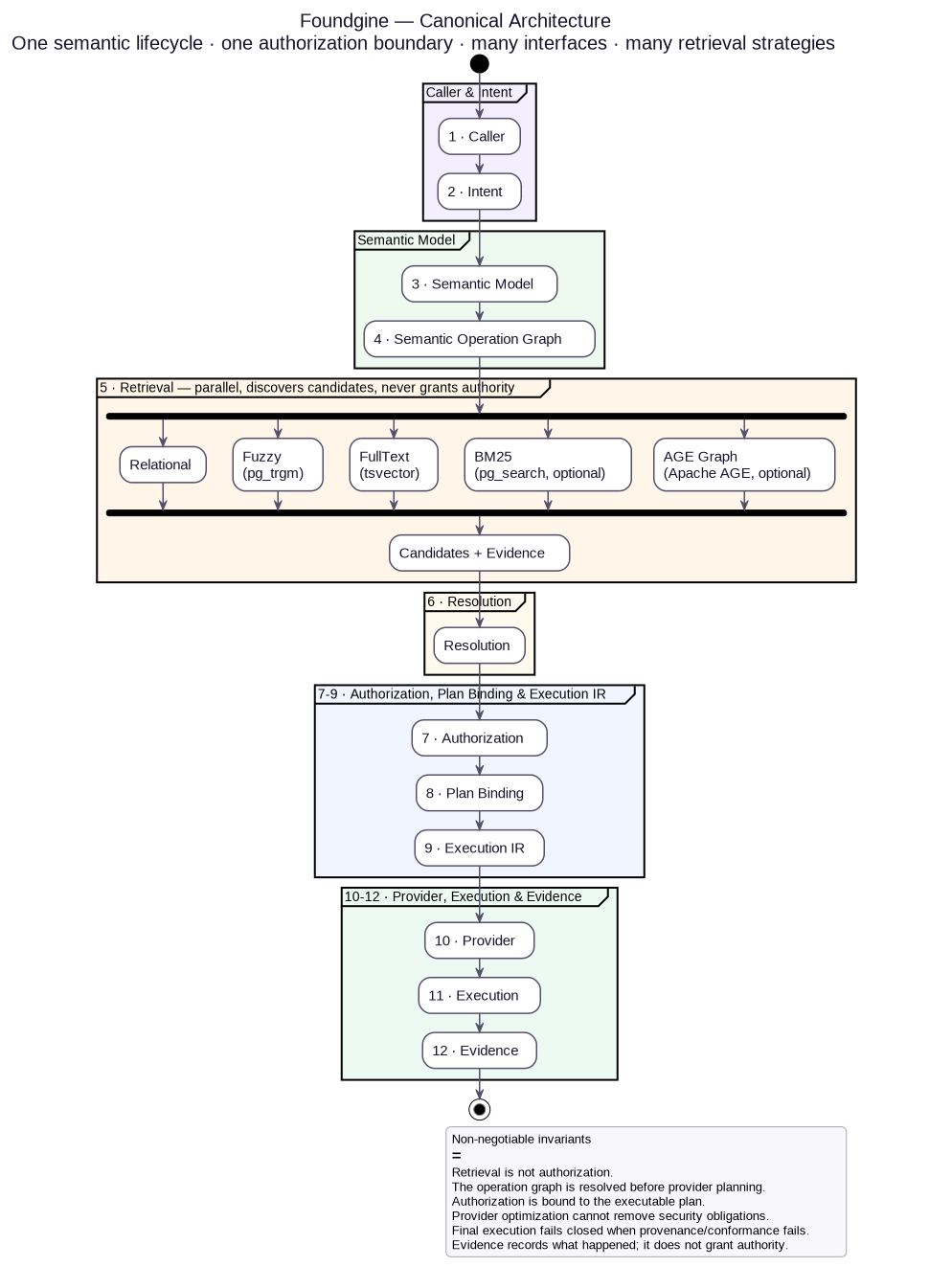
“Show me overdue purchase orders from our top supplier in Texas.”
Follow one natural-language request from the caller, through semantic resolution and retrieval, into authorization, plan binding, ExecutionIR, PostgreSQL and evidence.
Read only what you need.
The public site is the guided path. Each page is intentionally short and points to a deeper page or repository document when you want the implementation details.
| Stage | Start here | Go deeper |
|---|---|---|
| Understand | Why Foundgine? · What is Foundgine? | Why Foundgine · Application categories |
| Build | Getting started | Starter sample (.NET) · Starter sample (Java) · Runtime · Open Intent API |
| Design | Architecture | Metadata → Semantics · Mapping |
| Integrate | AI agents | AI agent guide · Packages |
| Secure | Security | Authorization · Security model |
| Prove | Samples | Benchmark evidence · Supply Chain E2E · PenTest |
Callers describe what they want. The application defines what exists and what is allowed. Foundgine determines how the authorized meaning executes.
For package selection, see Packages. For the tested application story, see the Supply Chain case study.